IASSC Lean Six Sigma Black Belt Exam Guide
The IASSC Certified Black Belt exam validates advanced understanding of Lean Six Sigma and the ability to apply DMAIC to complex improvement work. It is aimed at professionals who lead cross-functional initiatives, often in a full-time improvement role, rather than candidates seeking only an introductory process-improvement credential. This guide helps you decide whether the standard ICBB exam matches your experience, identify the skills that need deliberate practice, choose an efficient study sequence, and prepare for the documented exam conditions without relying on unauthorized question material.
What does the IASSC Certified Black Belt credential represent?
The IASSC Certified Lean Six Sigma Black Belt, listed by PeopleCert as Lean Six Sigma – IASSC Certified Black Belt (ICBB), is positioned as an advanced credential for professionals who lead complex improvement projects across functions. Its scope goes beyond knowing terminology: the candidate must be ready to interpret data, guide a DMAIC effort, and connect process improvement with organizational results.
The official badge description characterizes a Black Belt as someone well versed in the Lean Six Sigma methodology who leads complex improvement projects, typically in a full-time capacity. It also describes advanced competence across Define, Measure, Analyze, Improve, and Control (DMAIC), including the ability to implement, perform, interpret, and apply the method.
That positioning matters when choosing your preparation level. If your work involves facilitating a team, defining a measurable problem, selecting an analysis, validating a change, and establishing controls, the credential aligns with those responsibilities. If you are still learning basic process-improvement vocabulary, begin with the syllabus and foundational training before attempting advanced practice questions.
Who should take the Black Belt exam?
The exam is most suitable for professionals expected to lead complex improvement initiatives, coordinate stakeholders, and make evidence-based decisions throughout DMAIC. It can fit quality, operations, supply-chain, service, engineering, healthcare, technology, and project leadership roles when the candidate must improve a process rather than simply describe one.
PeopleCert’s stated learning outcomes include strategic DMAIC leadership, advanced statistical analysis, process mapping and optimization, performance control systems, Lean integration and waste reduction, and change and stakeholder leadership. These outcomes make the certification relevant to a practitioner who must combine technical analysis with team direction and implementation discipline.
A Green Belt may lead improvement projects or support more complex projects part time, according to the PeopleCert badge information. The Black Belt role is presented at a higher level, with responsibility for complex projects and advanced application. Use that distinction as a practical decision rule: choose Black Belt preparation when you need to own the improvement system, not only contribute to a workstream.
Before booking, write down one real process problem you understand. Identify its customer, output, defect or delay, likely measures, and stakeholders. If you cannot yet distinguish a business problem from a vague symptom, reserve time for Define and Measure fundamentals before concentrating on advanced statistics.
Are there prerequisites or required project submissions?
PeopleCert states that the certification has no prerequisites. The official badge information also says there are no formal entry criteria to sit for the exam, while advising that training is strongly advised. The absence of a formal prerequisite does not remove the need for preparation: the syllabus covers advanced application, and the standard exam is closed book.
No official requirement for a completed project submission is included in the supplied facts. Do not assume that a workplace project, portfolio, or prior belt certificate is required unless the current PeopleCert registration information says so. A practical project is still useful as a study laboratory because it forces you to connect tools to decisions.
Use the no-prerequisite policy to assess access, not readiness. A candidate with no formal Lean Six Sigma credential may sit the exam, but should still be able to explain why a measure is operationally defined, how variation affects a conclusion, and how a control plan prevents regression. Those abilities are more meaningful readiness indicators than the absence of an entry requirement.
What skills does the exam expect you to use?
Prepare for application rather than isolated definitions. The official learning outcomes point to six connected capabilities: leading DMAIC strategically, analyzing data statistically, mapping and optimizing processes, building performance controls, integrating Lean waste reduction, and leading change with stakeholders. Your study plan should make you practice the decision that follows each tool.
DMAIC is the organizing model. The official syllabus describes Lean Six Sigma as using Define, Measure, Analyze, Improve, and Control, and describes the method as systematically removing waste and reducing variation through collaborative team effort. Treat each phase as a chain of evidence, not as a list to memorize.
In Define, practice turning a broad complaint into a problem statement, goal, scope, customer requirement, and project rationale. In Measure, focus on operational definitions, data quality, baseline performance, and process understanding. In Analyze, connect suspected causes to appropriate evidence instead of accepting a plausible explanation without testing it.
In Improve, compare solutions against requirements, risk, feasibility, and expected process effect. In Control, make the result durable through monitoring, ownership, reaction rules, and documented standard work. Throughout the phases, keep asking whether the proposed action reduces waste, reduces variation, or both.
The Black Belt learning outcomes also include stakeholder and change leadership. Therefore, do not study statistics in isolation. Practice explaining a result to an operator, process owner, sponsor, or executive in terms of risk, decision, and next action.
How is the standard exam structured?
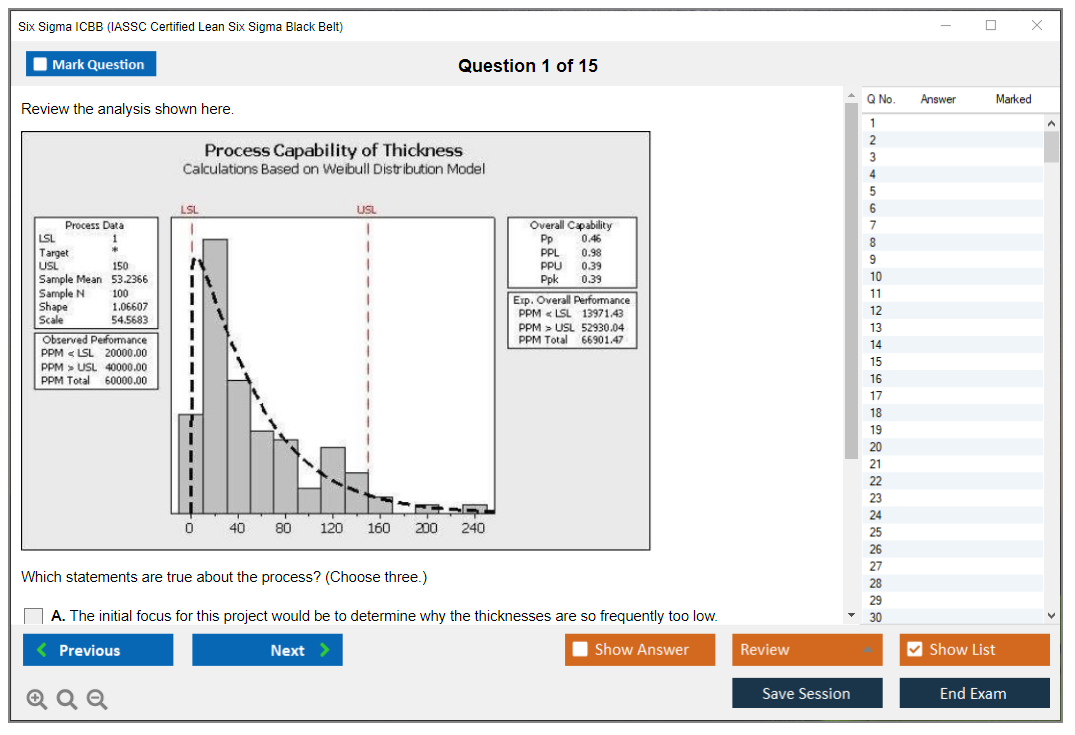
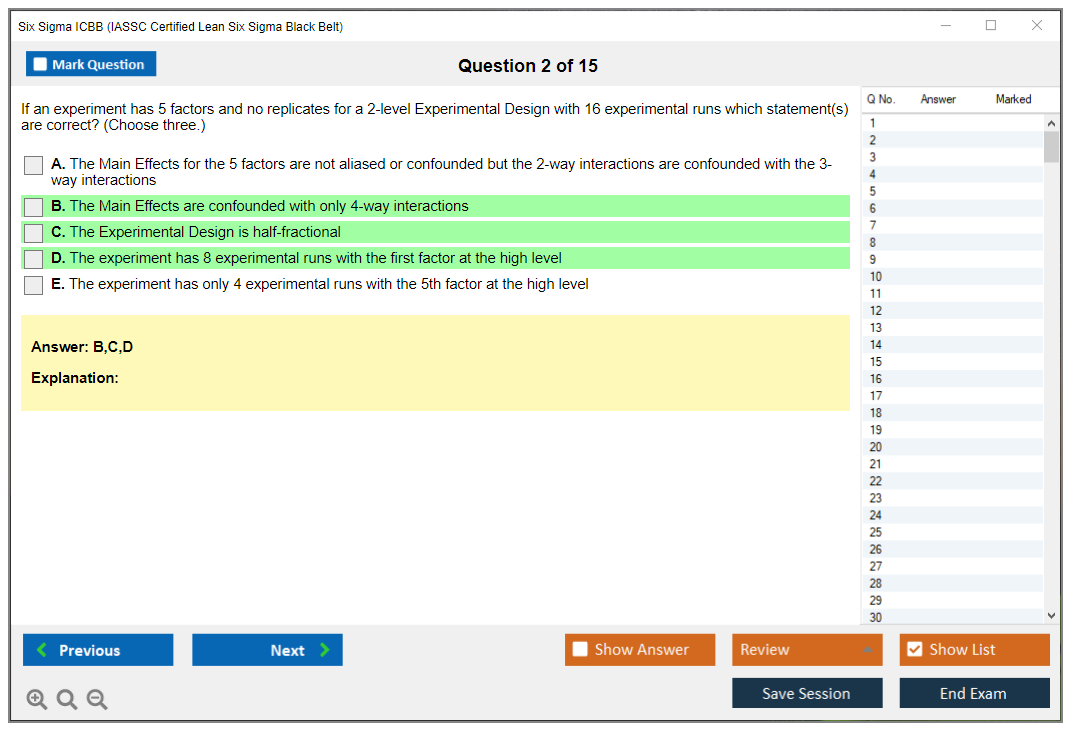
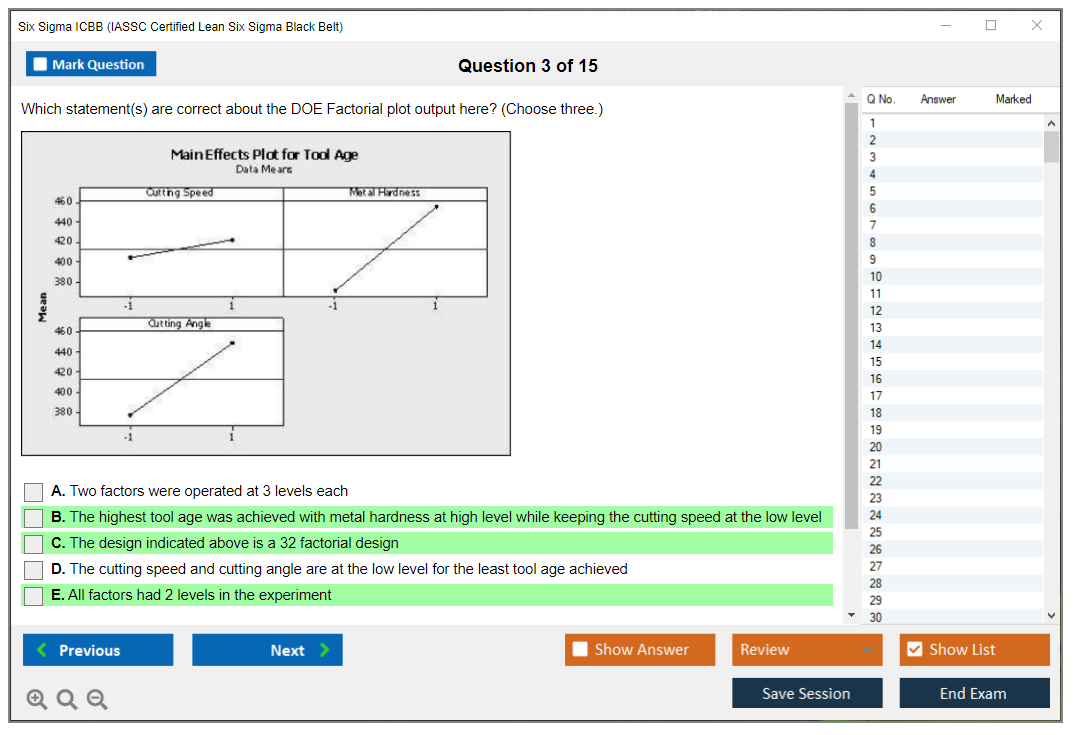
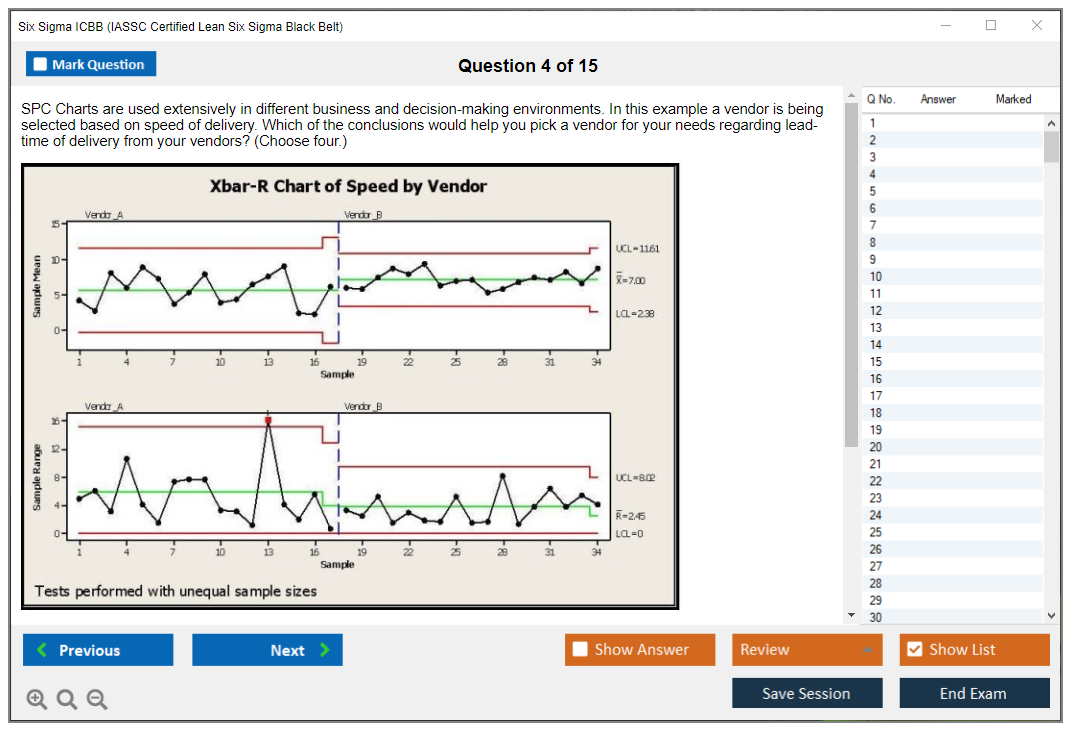
The standard exam contains 150 multiple-choice questions, lasts 240 minutes, is closed book, and requires a minimum passing score of 70%, according to the PeopleCert certification page. These conditions make pacing, interpretation, and recall important; preparation should include timed work as well as untimed learning.
The documented exam is not an open-reference exercise. The exam interface provides a reference document containing the required formulas and tables, and external copies are not permitted. Study the meaning and selection of formulas instead of trying to reproduce every table from memory, but become comfortable reading a formula, identifying its inputs, and checking whether its assumptions fit the problem.
The standard exam is available in English, French, Japanese, and Latin Spanish. Confirm the language and current scheduling details during registration, particularly if technical vocabulary is easier for you in one of those languages. The supplied facts do not establish that every preparation resource or interface feature is available in every language.
PeopleCert states that the exam can be taken remotely from home or an office 24/7 through an exam voucher. Availability of a remote option does not eliminate the need to review current booking, identification, equipment, environment, and proctoring instructions. Treat the certification page and booking workflow as the authority for those operational details.
How should you interpret the passing requirement?
A minimum passing score of 70% is an official requirement for the standard exam, but it is not a study target that justifies guessing through weak domains. Build a buffer by reviewing missed concepts, because a practice result can reflect familiarity with a question style rather than reliable Black Belt judgment.
Use three readiness signals together: accurate answers on unfamiliar scenarios, a clear reason for rejecting distractors, and the ability to move through calculations without losing the process context. A candidate who can select a formula but cannot explain what the result means still has an interpretation gap.
Do not convert the pass score into a claim about how many questions you will answer correctly on a particular attempt. The official requirement states the score threshold, while individual preparation results and question difficulty vary. Record your practice errors by cause: terminology, phase selection, statistical reasoning, arithmetic, or careless reading.
When reviewing a wrong answer, write a short correction in this form: “The question is asking for [decision]; the relevant evidence is [measure or analysis]; the tempting alternative fails because [reason].” This creates decision memory rather than a collection of answer letters.
What should you study in Define and Measure?
Define and Measure establish whether the project is asking a useful question and whether the data can answer it. Start here even if you prefer statistics: weak scope, vague defects, or inconsistent measurement definitions can invalidate later analysis and lead to an improvement that solves the wrong problem.
Build a Define checklist containing the business need, customer or user impact, problem statement, objective, scope boundaries, stakeholders, project roles, and expected benefit. Then test each item against a hypothetical project such as reducing order-entry errors or shortening a service response process. Keep the example generic; the point is to practice structure, not predict an exam question.
For Measure, practice translating a characteristic into an operational definition. Specify what counts as a defect, when measurement starts and ends, the unit of measure, the sampling context, and who records the result. Ask whether two people would classify the same event consistently.
Study process maps as measurement tools, not decorative diagrams. Trace inputs, activities, handoffs, queues, rework loops, and outputs. Mark where data is created and where delays or defects can be observed. This connects process understanding to a defensible baseline.
A common mistake is to begin collecting a large amount of data before defining the measure. A better sequence is to define the question, confirm the measure, examine the data-collection method, and only then plan analysis. If measurement reliability is uncertain, make that uncertainty visible rather than treating the data as fact.
How can you prepare for Analyze questions?
Analyze preparation should answer one question repeatedly: what evidence supports a root-cause conclusion? Learn to distinguish a suspected cause, a correlation, a statistically supported relationship, and a verified process mechanism. The best answer is usually the one that matches the data type, study purpose, and stated assumptions.
Create a decision table for common analytical situations. Include the response type, factor type, number of groups or conditions, distribution or variance concerns, and the question the method answers. The table is a study aid you create; it is not a claim about an official question distribution.
Practice reading outputs conceptually. Identify the null or comparison being made, the evidence threshold described by the scenario, the practical meaning of the result, and the limits of the conclusion. Then translate the finding into a process action: collect better data, investigate a cause, test an improvement, or stop pursuing an unsupported explanation.
Review variation in context. A process can have a stable pattern and still perform poorly against customer requirements; it can also show apparent improvement that is not sustained. Practice separating central tendency, spread, process behavior, and customer performance rather than using “better” as a substitute for analysis.
For every statistical method in your notes, add four lines: when to use it, what data it needs, what decision it supports, and what could make the result misleading. This is more useful than memorizing a procedure name without understanding its role in DMAIC.
How should Lean tools and waste reduction fit the preparation?
Lean is not a separate vocabulary section to memorize after Six Sigma. The official syllabus describes Lean Six Sigma as removing waste and reducing variation through collaborative team effort, so study Lean tools in relation to flow, customer value, unnecessary work, waiting, handoffs, and process stability.
When reviewing a process map, look for work that does not add customer value, delays between activities, duplicated entry, excess movement, avoidable inventory or queues, rework, overproduction, and unused team capability. Then ask whether the remedy should change the sequence, remove an activity, reduce a handoff, standardize work, or address variation first.
Avoid treating every visible delay as a statistical problem or every defect as a simple waste category. A process may need both flow improvement and variation reduction. A fast process that produces inconsistent output can create rework; a stable process with excessive handoffs can still waste time. Your analysis should identify the mechanism before selecting the tool.
Use one end-to-end example during revision. Map the current state, identify customer value, locate queues and rework, define a measurable defect, and propose an improvement that changes the process rather than asking people to work harder. This makes Lean concepts easier to retrieve when a scenario combines flow and quality concerns.
What belongs in Improve and Control revision?
Improve is the point where evidence becomes a controlled change, while Control protects the gain after the project team moves on. Study both phases together so that every proposed solution has an implementation owner, a verification measure, and a response when performance moves outside the intended condition.
For Improve, compare alternatives against the defined problem, customer requirements, process constraints, risk, and expected effect. Consider whether the solution removes a cause or merely detects a defect later. Think through failure modes, pilot or trial design, standard work, training needs, and the effect on upstream and downstream processes.
For Control, practice designing a monitoring system that states what is measured, how often, by whom, against which limit or requirement, and what action follows an adverse signal. Include process ownership, documentation, handover, audit or review arrangements, and a plan for responding to recurrence.
A frequent error is to call a completed implementation “control.” Installation is not evidence of sustained performance. Control requires a defined way to see whether the process remains capable of meeting its intended outcome and a credible reaction plan when it does not.
Test your notes with this question: if the original project team disappeared next week, who would know that performance was deteriorating, and what would that person do? If the answer is unclear, your Control preparation is incomplete.
How do you prepare for stakeholder and change questions?
Black Belt work requires adoption as well as analysis. Prepare to identify who sponsors the change, who owns the process, who supplies data, who performs the work, who receives the output, and who may be affected. The right engagement approach depends on influence, impact, knowledge, and the decision required.
Build a stakeholder plan for a sample project. Give each stakeholder a concern, needed information, decision authority, and appropriate communication. An executive may need a concise case for action; an operator may need a clear change to standard work; a data owner may need agreement on definitions and access.
Study resistance as information rather than as a character flaw. Resistance may indicate an unsafe change, an unmeasured workload, a conflicting target, poor communication, or a legitimate measurement concern. Investigate the source, involve the right people, and use process evidence to refine the implementation.
Link the change conversation to DMAIC evidence. A stakeholder should be able to see why the problem matters, how the baseline was established, what cause was supported, what the improvement changes, and how control will detect regression. This narrative helps you answer scenario questions that test leadership judgment rather than calculation alone.
What is a practical study sequence?
A strong sequence follows the logic of a project: establish the method, build phase-by-phase understanding, strengthen quantitative reasoning, then rehearse integrated decisions under timed conditions. Do not begin with random question sets before you know why a tool belongs in a particular DMAIC phase.
First, read the official Black Belt syllabus and certification page together. Mark every topic or outcome you can explain and every one that remains only a familiar term. Create a gap list with separate columns for concept, application, calculation, interpretation, and leadership.
Next, study DMAIC in order. For each phase, produce a one-page workflow: purpose, inputs, key decisions, outputs, common failure modes, and links to the next phase. Add Lean waste reduction and stakeholder actions where they naturally affect the work rather than placing them in an isolated glossary.
Then develop quantitative fluency. Work through representative data exercises from legitimate training materials, focusing on choosing a method, checking assumptions, interpreting results, and communicating the decision. Keep an error log. Rework missed items after a delay so that you test recall rather than immediate recognition.
Finish with mixed practice. Combine phase selection, process mapping, Lean, statistical reasoning, improvement design, control planning, and change leadership. A Black Belt scenario may require you to recognize that the technically attractive action is premature because the measure, scope, or cause has not been established.
A four-stage roadmap
Stage one is orientation. Confirm that you are preparing for the standard ICBB exam rather than the Black Belt recertification exam, download or review the current syllabus, and inventory your experience. Decide whether you need structured training, self-study, or both; the official badge information strongly advises training even though there are no formal entry criteria.
Stage two is capability building. Work through Define and Measure before Analyze, because analysis is only meaningful when the problem and data are sound. Follow with Improve and Control, then revisit Lean integration and stakeholder leadership across the full project. Use a single practice process to connect the phases.
Stage three is diagnostic practice. Use topic-specific exercises first, then mixed sets. For every miss, label the cause and revise the underlying note. If your errors cluster around calculations, practice setup and interpretation. If they cluster around scenarios, rewrite the decision logic and distinguish phase purpose from tool name.
Stage four is exam rehearsal. Use an official timed mock exam when useful; PeopleCert describes its Black Belt mock exam as full, timed, and marked, with a report identifying improvement areas after completion. Review the report as a diagnostic, not as evidence that future exam questions will repeat.
The final review should be selective. Revisit your error log, formula meanings, DMAIC outputs, control decisions, and confusing terminology. Avoid replacing understanding with last-minute memorization of unauthorized material.
How should you use practice exams and questions?
Practice questions are valuable when they reveal a reasoning gap, not when they become a hunt for repeated wording. Use them in two modes: untimed learning for explanation and correction, followed by timed mixed work for pacing. Never treat dumps, leaked questions, or memorized answer lists as a legitimate substitute for competence.
For each item, answer before looking at explanations. Record the phase, decision, evidence, and reason the distractors fail. If you guessed correctly, mark it as uncertain and review it; a lucky answer is not mastery. Group errors by pattern so that the next study session addresses causes rather than symptoms.
The official PeopleCert mock exam is described as full, timed, and marked, with a report identifying improvement areas. That makes it useful late in preparation, after you have learned the syllabus. Check the current product page for its present terms and availability rather than assuming that any third-party practice product follows the official format.
Do not infer official weighting, question distribution, or live exam content from a mock exam. The supplied official facts do not provide domain percentages or a guaranteed topic allocation. Prepare across the syllabus and use practice performance to decide where to spend more time.
What mistakes commonly weaken Black Belt preparation?
The most damaging mistakes are sequencing errors: memorizing tools without phase logic, choosing analysis before validating the measure, proposing solutions before confirming causes, and treating Control as a final report. Correct these by requiring every study note to state the decision a tool supports and the evidence needed to use it responsibly.
Mistake one is studying only definitions. A definition may identify a concept, but scenario questions require selection, interpretation, and consequence. After learning a term, write a small process example and explain what would change if the term were misunderstood.
Mistake two is over-focusing on arithmetic. Calculations matter, but a correct result attached to the wrong data or question is still a poor decision. Practice identifying the response, factors, comparison, assumptions, and practical meaning before calculating.
Mistake three is ignoring people and implementation. A statistically sound improvement can fail if ownership, training, incentives, workload, or communication are absent. Add stakeholder and change considerations to each project exercise.
Mistake four is confusing standard and recertification information. The standard exam has 150 multiple-choice questions and lasts 240 minutes; the recertification exam has 75 multiple-choice questions and lasts 120 minutes. Those are different routes. Confirm which product you are booking before relying on format notes or scheduling assumptions.
Mistake five is using unsupported exam claims. Avoid websites that promise exact live questions, guaranteed success, or a shortcut based on memorization. Prepare from the current PeopleCert information, the official syllabus, legitimate training, and practice that teaches reasoning.
What should you verify before scheduling?
Before scheduling, verify that the product is the standard ICBB exam, select an available language, review the current delivery instructions, and confirm that your equipment and testing environment meet the provider’s requirements. These checks are administrative, but overlooking them can disrupt an otherwise sound preparation plan.
The supplied official information states that the exam can be taken remotely from home or an office 24/7 through an exam voucher. Check the current PeopleCert booking workflow for the exact voucher terms, identity requirements, technical checks, rescheduling rules, and any local conditions. Those details can change and are not all established by the supplied facts.
The standard exam is documented as closed book, with an on-screen reference document containing required formulas and tables; external copies are not permitted. Plan your revision around using the permitted interface resource rather than preparing a physical formula sheet for use during the exam.
The standard exam is available in English, French, Japanese, and Latin Spanish. Choose the language in which you can read statistical and process-improvement scenarios precisely. If you study in a different language from the exam, build a personal glossary before booking and check the official page for the available examination and support language details.
PeopleCert states that the certification is renewable every three years. Record the renewal point after certification and review the current recertification route when that time approaches. Do not confuse the renewal pathway with the initial standard exam.
How is Black Belt recertification different?
Recertification is a separate route for holders of the IASSC Lean Six Sigma Black Belt credential who earned it three or more years earlier. It is not the format to use for a first attempt. Confirm your eligibility and the current PeopleCert recertification page before purchasing or scheduling.
The documented Black Belt recertification exam has 75 multiple-choice questions, lasts 120 minutes, is closed book, and requires a minimum passing score of 70%. These details apply to recertification, not the standard ICBB exam. Keep separate notes and practice plans for the two routes.
The recertification page lists a recertification exam voucher price of US$335. Because prices and purchasing conditions can change, verify the live PeopleCert page at the point of booking. The standard certification page separately lists the standard exam voucher price as US$516; do not use one route’s price as a general price for the other.
For a first-time candidate, the useful next action is simple: open the standard ICBB page, confirm the product name, and compare it with the recertification page only if you already hold the credential and meet the stated timing condition.
What should you do in the final week?
The final week should reduce uncertainty, not expand the syllabus indefinitely. Complete one realistic timed rehearsal, review every error by cause, revisit weak DMAIC transitions, and confirm the delivery setup. Stop collecting new sources when they begin to compete with the official syllabus and your error log.
Use the first study sessions for Define, Measure, and phase sequencing. These areas determine whether later analysis and improvement choices are coherent. Follow with targeted statistical review, especially method selection and interpretation, then finish with Lean flow, Control plans, and stakeholder decisions.
In the last days, practice concise explanations. For a scenario, state the decision, cite the relevant evidence, identify the appropriate phase or tool, and explain why the alternative is premature or unsuitable. This improves both speed and precision without requiring access to live questions.
Prepare only what the delivery rules permit. Since the exam is closed book and provides its own reference document, do not plan to consult external formula sheets or other copies. Recheck the current PeopleCert instructions for the remote environment, and leave enough time for technical checks before the appointment or chosen session.
If practice performance remains inconsistent, rescheduling may be more responsible than trying to compensate with question memorization. The purpose of the credential is advanced application; your preparation should demonstrate that you can make defensible improvement decisions under documented exam conditions.
What are the next actions after reading this guide?
Start with the official syllabus, map your current strengths against each learning outcome, and choose a study method that addresses your largest gap. Then decide whether the standard ICBB exam is appropriate now or whether foundational training and applied project experience should come first.
Complete these actions in order: confirm the standard versus recertification route; read the current PeopleCert certification page; build a DMAIC study map; choose a practice process; create an error log; perform topic-based exercises; complete integrated timed practice; and verify booking and remote-delivery instructions immediately before scheduling.
Use the credential as a capability project, not merely a test event. Your final readiness check should be whether you can define a meaningful problem, establish trustworthy measures, analyze causes, select and implement an improvement, control the result, and lead the people affected by the change. That is the practical standard reflected in the Black Belt scope.
Conclusion
The standard IASSC Certified Lean Six Sigma Black Belt exam is a substantial assessment of DMAIC application, statistical reasoning, Lean integration, control design, and improvement leadership. The most reliable preparation path is to study from the official syllabus, connect every tool to a process decision, diagnose errors through legitimate practice, and verify current PeopleCert delivery information before booking. Once your preparation shows consistent reasoning across the full improvement cycle, schedule the standard ICBB exam with a clear understanding of its documented format and your own remaining risks.